Reviving an Austin lawn after freeze or drought damage
By Rachel Delgado · Updated 2026-07-06
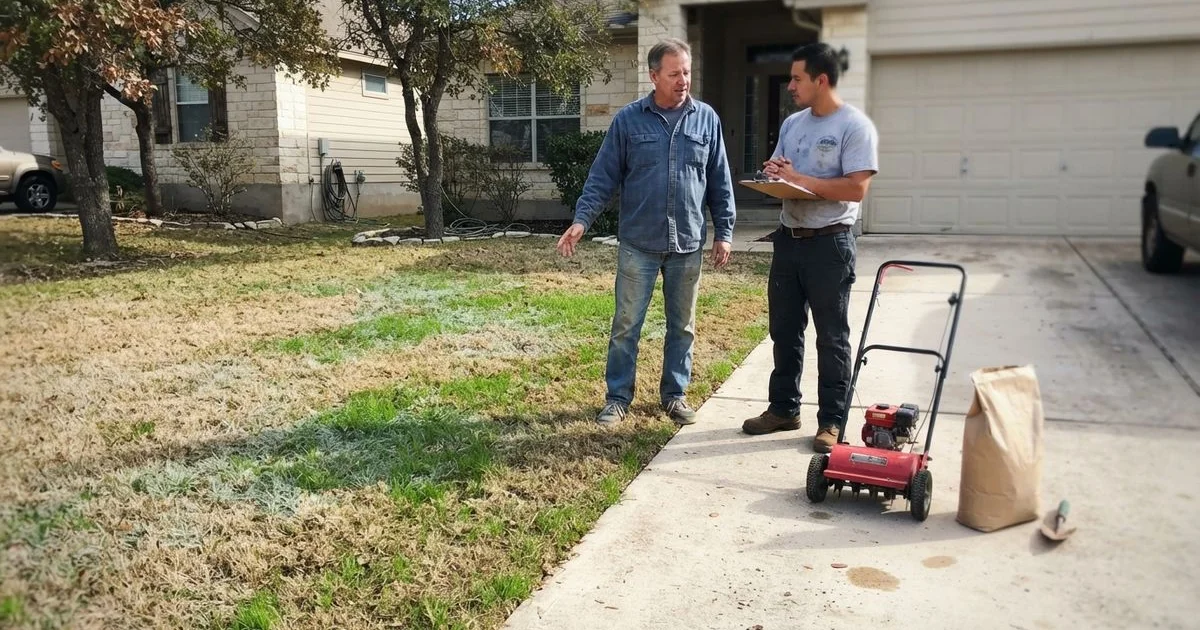
Austin lawns take a beating from both directions: hard winter freezes that can damage warm-season grasses, and long summer stretches of drought and heat restrictions. Knowing which situation you’re actually dealing with changes what recovery looks like.
Freeze damage: dormant vs dead
After a hard freeze, most Austin lawns (St. Augustine and Bermuda especially) will look brown and lifeless for a while, and that’s often just dormancy, not death. The grass is protecting itself by going dormant rather than trying to grow through cold it isn’t built for. Give it time before assuming the worst.
| Sign | Likely dormant | Likely dead |
|---|---|---|
| Grass color | Brown or tan overall | Brown, often patchy or uneven |
| Tug test | Holds firm at the roots | Comes up easily, no root resistance |
| Timing | Right after a freeze | No green growth well into the season |
| Pattern | Even across the lawn | Isolated patches, uneven |
A simple way to check: gently tug on a patch of grass. If it resists and stays rooted, it’s more likely dormant and will green back up once temperatures rise. If it pulls up easily with no resistance, that section is more likely dead and will need reseeding or new sod.
What actually helps freeze-damaged grass recover
Resist the urge to overwater or heavily fertilize a lawn right after a freeze, since the grass isn’t actively growing yet and won’t use it well. Once temperatures stabilize and you see the first signs of new green growth, that’s the point to resume a normal watering and feeding schedule to support the recovery already underway.
Drought damage is a different problem
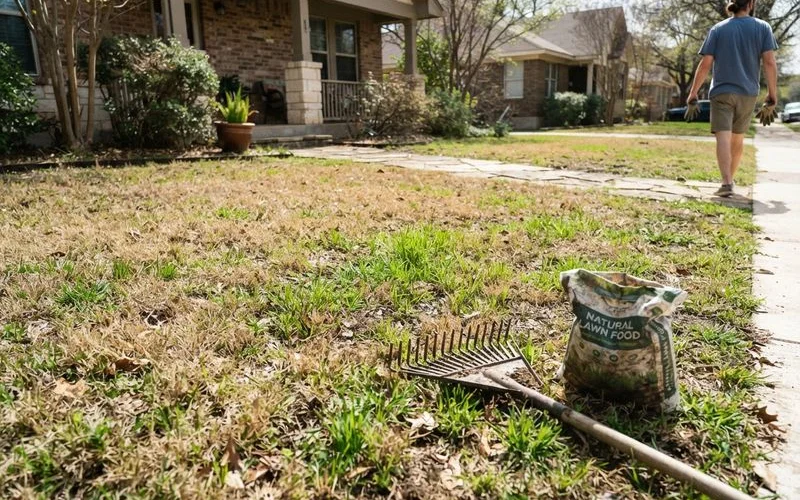
Drought stress shows up differently: grass that’s uniformly thin, curling, or grayish rather than the patchy pattern typical of freeze damage or disease. Austin’s summer watering restrictions mean lawns often can’t get watered as often as they’d need to stay fully green through peak heat, and some browning during summer is normal rather than a sign of a dying lawn.
Helping a drought-stressed lawn without wasting water
Deep, infrequent watering (within whatever restrictions are currently in place) encourages roots to grow deeper and handle heat better than frequent shallow watering does. Raising the mower height slightly during peak summer also helps, since taller grass shades its own roots and retains moisture better than a lawn cut very short.
When to reseed or re-sod instead of waiting
If large sections show no recovery well into the growing season, or if freeze or drought damage killed off patches unevenly, waiting for natural fill-in can take a long time, if it happens at all. Reseeding matched to your existing grass type, or laying new sod in badly damaged sections, is usually the faster route back to a full lawn.
Weeds tend to move in first
One frustrating pattern after freeze or drought damage: weeds often recover and spread faster than the stressed turf grass around them, since they’re less picky about conditions. If you see weeds filling in ahead of the grass, that’s a sign to address them directly rather than assuming the lawn will simply out-compete them once it recovers, since a head start for weeds can be hard to reverse without some intervention.
Preventing repeat damage next season
If the same sections of lawn struggle every winter or every summer, that’s worth investigating rather than just repeating the recovery process annually. Low spots that hold cold air longer, areas with poor drainage that stay saturated, or a patch getting less sun than the rest of the lawn can all cause a specific section to consistently underperform. A soil test or a professional assessment can identify whether the issue is fixable (drainage, compaction) or whether that section might do better with a different grass type or ground cover altogether. Our seasonal lawn care calendar can help you get ahead of freeze and drought stress before it sets in next time.
A realistic timeline for full recovery
Full recovery from a hard freeze often takes until well into the growing season to look complete, and drought recovery depends heavily on how much supplemental watering is possible within current restrictions. Patience matters here: pushing a stressed lawn hard with fertilizer or reseeding too early, before it’s actually ready to respond, tends to waste effort rather than speed things up.
To find lawn care providers experienced with Austin’s freeze and drought recovery, visit the lawn care and maintenance hub. See our methodology for how listings are evaluated, and learn more about this directory on the homepage.
FAQ
- Will my lawn recover on its own after a hard freeze?
- Often yes, especially St. Augustine and Bermuda, which are used to going dormant. Give it a full growing season before assuming it's dead, since what looks brown in early spring can green back up as temperatures rise.
- How can I tell if grass is dormant or actually dead?
- A simple check is tugging gently on a patch of grass. If it comes up easily with no resistance at the roots, that section is more likely dead. If it holds firm, it's more likely just dormant.
- Should I water a freeze-damaged lawn more to help it recover?
- Not immediately after a freeze, since the ground may still be recovering too. Once temperatures stabilize and active growth resumes, resuming a normal watering schedule supports recovery better than overwatering early.
- When does it make sense to reseed or re-sod instead of waiting?
- If large sections show no green growth by well into the growing season, or if the damage is patchy and uneven, reseeding or re-sodding those areas is usually faster than waiting on natural fill-in.
Related on this site
- Browse lawn care & maintenance providers
- Best lawn care & maintenance in Central Texas →
- What lawn care costs in Austin: mowing, maintenance, and what changes your rate
- DIY lawn care vs hiring a pro in Austin: what actually makes sense
- A seasonal lawn care calendar for Austin
- Getting your yard ready to sell a house in Austin
- All guides →