Warning signs your tree is sick or dying in Austin, and what to do next
By Rachel Delgado · Updated 2026-06-26
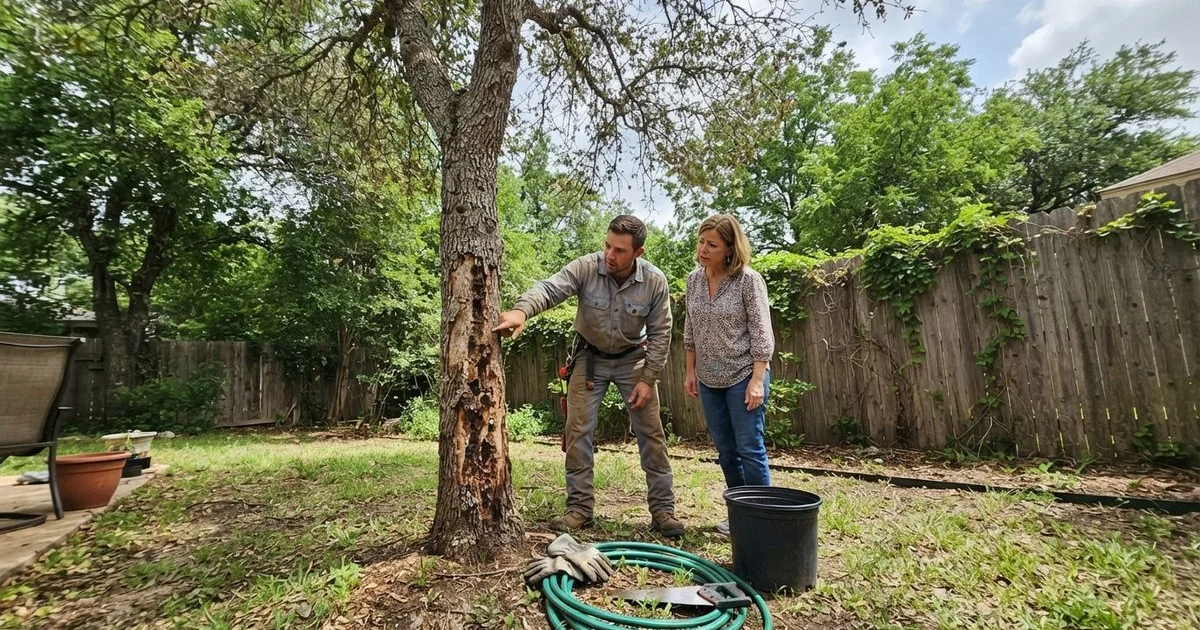
A tree in decline doesn’t always announce itself clearly. Some signs are obvious, a large dead limb or bark falling away in sheets, but others are subtle enough that homeowners miss them until the tree is well past the point of easy treatment.
The signs worth taking seriously
A few patterns show up again and again in Austin trees that turn out to be in real trouble:
- Uneven leaf loss. Leaves thinning or dropping in one section of the canopy while the rest looks normal often points to disease or localized damage, not just seasonal change.
- Bark changes. Cracking, peeling in sheets, or oozing sap in unusual spots can signal infection or internal decay.
- New lean or lifted soil at the base. A tree that starts leaning, especially with soil cracking or lifting near the trunk, may have compromised roots and can be a real safety risk.
- Fungal growth at the base or on the trunk. Mushrooms or shelf-like fungus growing on a tree is often a sign of internal decay that’s already fairly advanced.
- Dead branches concentrated at the top. Dieback starting at the crown and working down is a common pattern in stressed or struggling live oaks.
| Sign | Possible cause | Urgency |
|---|---|---|
| Even leaf drooping, whole tree | Drought stress | Moderate, often treatable |
| Uneven canopy dieback | Disease, pest, or root damage | Higher, get assessed |
| New lean, lifted soil at base | Root failure | High, safety concern |
| Fungal growth on trunk/base | Internal decay | High, get assessed soon |
What’s usually behind it in Central Texas
Drought stress is common in Austin summers and can mimic disease symptoms, which is part of why an accurate diagnosis matters before deciding on treatment or removal. Root damage from construction, grade changes, or compacted soil near the base is another frequent culprit, especially in yards that have had recent hardscape or foundation work nearby. Fungal disease affecting oaks is also a known regional risk, and it can spread between trees through connected root systems, which is one reason a fast, accurate diagnosis matters for neighboring trees too.
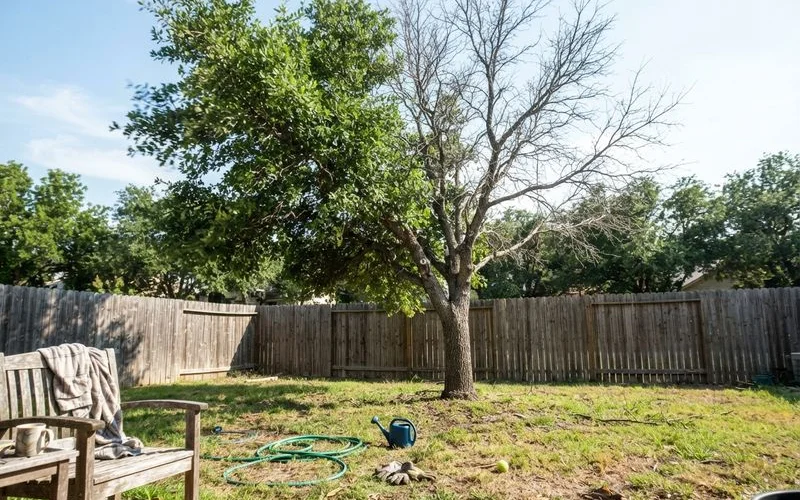
When to call an arborist
If you notice more than one of these signs together, or any sign involving the base of the trunk or a new lean, it’s worth getting an ISA certified arborist to assess the tree rather than waiting to see if it improves. Early assessment sometimes catches something treatable; waiting often means the only remaining option is removal.
This is general information, not medical or professional advice for tree care. A licensed arborist can give a diagnosis specific to your tree and property.
What an assessment usually involves
An arborist will typically look at the canopy, check the trunk and base for decay or fungal growth, and may take a soil sample or check for compaction near the roots. For valuable or large trees, a second opinion before committing to removal is a reasonable step, since removal is permanent and treatment, when viable, is worth attempting first. If removal ends up being the only option, our guide on how tree removal works in Austin, from quote to cleanup covers what happens next.
What treatment can look like when it’s caught early
Not every struggling tree needs to come down. Depending on the cause, treatment might mean adjusting a watering schedule for drought stress, aerating compacted soil near the root zone, applying a targeted fungicide for certain diseases, or simply pruning away a localized problem before it spreads further into the canopy. The earlier a real diagnosis happens, the more of these lower-cost options are still realistic, which is the main argument for not waiting once you’ve noticed more than one warning sign.
Protecting healthy trees nearby
If an arborist confirms a disease that spreads through root grafts or insect activity, ask what it means for other trees on the property or next door, since some tree diseases in Central Texas move between neighboring trees of the same species. Preventive steps, like avoiding unnecessary wounds to nearby trees during the same window, can sometimes reduce the risk of spread while the affected tree is being treated or removed.
To find tree service and arborist providers in your part of Austin, visit the tree service and arborist hub. Our methodology explains how businesses are evaluated and ranked. Learn more about this directory on the homepage.
FAQ
- Can a tree recover once it starts losing leaves out of season?
- Sometimes, depending on the cause. Drought stress and some early-stage diseases can respond to treatment or better watering. Advanced fungal infections or extensive root damage are harder to reverse.
- Is a leaning tree always dangerous?
- Not always, some trees grow with a natural lean. A tree that has recently started leaning, especially with soil lifting near the base, is a different situation and worth an arborist's assessment soon.
- How do I know if it's drought stress or disease?
- Drought stress tends to affect the whole tree evenly with drooping or curling leaves. Disease often shows up unevenly, in one section of the canopy or in specific branches, and can include unusual bark changes or fungal growth.
- Should I get a second opinion before removing a tree?
- For a large or valuable tree, yes. Removal is permanent, and a second arborist assessment can confirm whether treatment is realistic before you commit to taking the tree down.
Related on this site
- Browse tree service & arborist providers
- Best tree service & arborist in Central Texas →
- How tree removal works in Austin, from quote to cleanup
- Tree removal laws and permits in Austin: what homeowners need to know
- Who is liable when a tree falls and damages a neighbor's property in Austin
- Lawn chemical and pesticide safety for kids and pets in Austin
- All guides →